

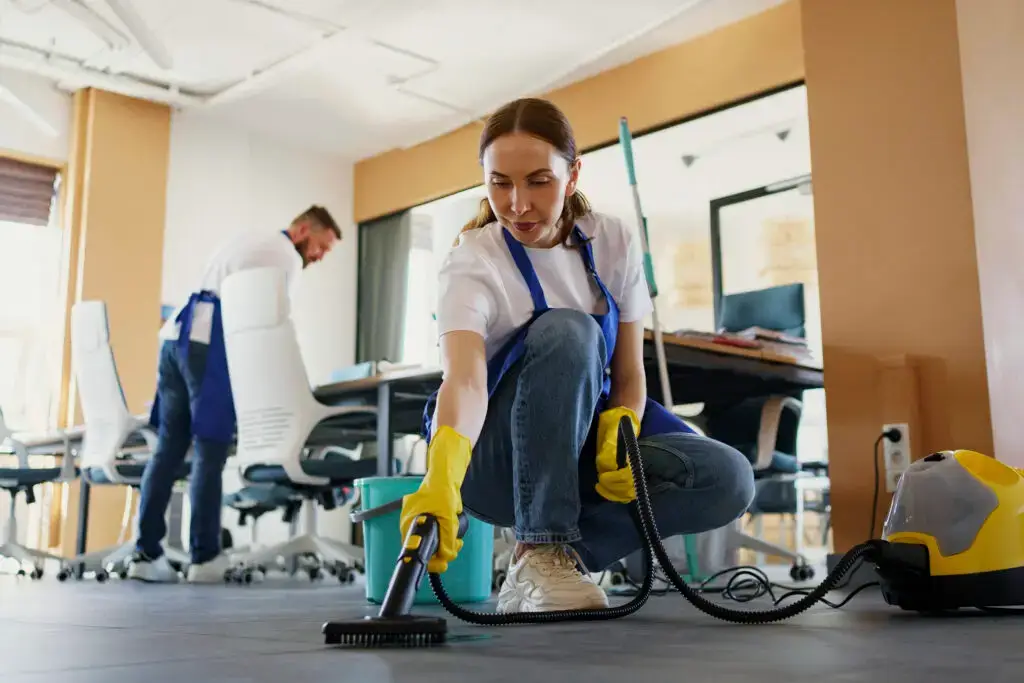
Most people notice when a workspace feels off. Papers piling up, dust on the monitor, a faint smell from the breakroom. What is less obvious is how much that environment quietly shapes the way people work, day after day, often without anyone naming the cause out loud.
The link between workplace cleanliness and productivity is not just an opinion held by tidy people. Researchers have studied how dust, clutter, and indoor air actually affect focus, memory, and how employees feel by the end of the day. This piece looks at what that research says and what it means for a real office, not just a hypothetical one.
Quick answer: Workplace cleanliness affects productivity through three main channels: indoor air quality, which influences cognitive performance, visual clutter, which adds mental load, and hygiene, which affects sick days and energy levels. Offices that manage all three tend to see steadier focus and fewer disruptions across the workday.
How workplace cleanliness and productivity are connected
The connection is not abstract. It shows up in measurable ways across a normal workday.
- Attention and focus. A cluttered desk gives the brain more to filter out before it can settle on the actual task.
- Cognitive performance. Indoor air quality affects how quickly and accurately people think, not just how comfortable they feel.
- Energy levels. Stale air, poor ventilation, and lingering odors are tied to that mid-afternoon sluggishness many employees blame on caffeine instead.
- Sick days. Shared surfaces that go uncleaned spread germs faster, which translates directly into absenteeism.
- First impressions. Clients and candidates form quick judgments about a business based on how the space looks and feels.
None of these factors work in isolation. A dusty, cluttered office with poor ventilation tends to compound all of them at once, which is why isolated fixes, like a single deep clean, rarely solve the underlying pattern on their own.
What research says about clean air and clean spaces
A multicountry study led by Harvard T.H. Chan School of Public Health followed office workers for a year and found that higher concentrations of fine particulate matter and lower ventilation rates were tied to slower response times and reduced accuracy on cognitive tests, even at levels common in everyday office buildings.<sup>[1]</sup> The researchers noted that the effects on cognitive function were measurable even when the air did not feel noticeably different to the people breathing it.
That finding matters for how offices think about cleaning. Surface-level tidiness is not the same as actual air quality, and dust, fabric, and carpet all play a role in what gets stirred back into the air employees breathe all day. A desk that looks clean can still sit in a room with poor ventilation and high particulate levels.
Visual clutter has its own body of research behind it too. Cluttered environments give the brain more visual information to process, which competes for the same attention employees need for their actual work. That is one reason a cleared desk often feels like an immediate relief, even before any task changes.
Why air quality is easy to overlook
Most cleaning routines focus on what is visible: dust on a desk, a stain on the carpet, fingerprints on a glass door. Air quality does not show up the same way. A room can look spotless and still have stale, particle-heavy air if ventilation is poor or filters have not been changed in a while.
This is part of why office managers sometimes feel confused when complaints about fatigue or headaches continue even after a thorough cleaning. The surfaces were addressed, but the air moving through the space was not part of that pass. Pairing regular surface cleaning with attention to ventilation, vents, and HVAC filters closes that gap.
The hidden cost of a cluttered or dirty workplace
Some of the costs of a neglected workplace are obvious. Others build up quietly over months, which makes them easy to underestimate until they show up in a budget or a turnover conversation.
- Lost time searching for things. Misplaced documents and supplies add up to real minutes lost every week.
- More frequent illness. Shared keyboards, phones, and doorknobs are common transfer points for germs in any office.
- Lower morale. Employees tend to take less pride in a space that feels neglected, which can affect how they treat it day to day.
- Reduced client confidence. A messy reception area or conference room can undercut an otherwise strong pitch.
- Faster equipment wear. Dust buildup inside electronics and HVAC systems can shorten their lifespan and reduce efficiency.
- Harder recruiting and retention conversations. Candidates and new hires notice the state of a workplace during their first visit, and a neglected space can quietly work against an otherwise strong pitch about company culture.
Professional cleaners who service offices regularly notice a pattern: the spaces that fall behind on cleanliness rarely fail in one dramatic way. It is usually a slow accumulation of small issues that eventually becomes obvious to everyone in the room.
Common cleanliness issues that quietly drain productivity
A few issues show up again and again in offices that struggle with this connection.
- Overflowing trash and recycling. Beyond the smell, this signals that basic upkeep is falling behind.
- Dust on vents and electronics. This affects both air quality and how efficiently equipment runs.
- Cluttered shared spaces. Conference rooms and breakrooms that double as storage areas create friction every time someone tries to use them.
- Carpets that look fine but trap dust. Visible cleanliness and air quality are not always the same thing.
- Inconsistent restroom upkeep. Few things affect employee perception of a workplace faster than a poorly maintained restroom.
Building cleanliness into a productive workplace culture
Cleanliness works best as a habit built into how a team operates, not a one-time project.
- Set clear expectations for shared spaces. A simple norm, like clearing dishes after breaks, prevents small messes from becoming bigger ones.
- Schedule cleaning around actual usage. High-traffic areas need more frequent attention than rarely used offices or storage rooms.
- Prioritize ventilation, not just visible dust. Air quality improvements often matter more for focus than surface tidiness alone.
- Make supplies easy to access. Employees are more likely to clean up after themselves when wipes, trash bins, and supplies are within reach.
- Treat cleanliness as part of onboarding. New hires absorb workplace norms quickly, including how the team treats shared spaces.
- Review the routine when the office changes. Adding desks, changing layouts, or shifting to more in-person days usually means the existing cleaning schedule needs a second look.
How often different areas need attention to stay productive
Cleaning frequency should match how a space is actually used, not a fixed company-wide rule.
- Daily: Shared desks, doorknobs, breakroom surfaces, and high-traffic floors.
- Weekly: Private offices, conference rooms, and carpets in moderately used areas.
- Monthly: Vents, light fixtures, and furniture in lower-traffic spaces.
- Quarterly or twice a year: Deep cleaning of carpets and upholstery to address what regular cleaning leaves behind.
Offices in humid climates, including much of South Florida, often need to pay closer attention to drying times after cleaning, since lingering moisture can affect both air quality and odor faster than in drier regions.
Signs your workplace cleanliness routine isn’t working
A few warning signs tend to show up before anyone formally complains.
- Employees mention feeling tired or unfocused by midafternoon
- Sick days cluster around the same few weeks each season
- Dust or clutter reappears within days of being addressed
- Clients or visitors comment on the state of common areas
- Shared equipment, like keyboards or phones, looks visibly worn or grimy
If more than one of these shows up consistently, it is usually a sign that the current cleaning routine no longer matches how the space is being used.
Frequently asked questions about workplace cleanliness and productivity
Does workplace cleanliness really affect productivity, or is it just a perception? Both. Employees often perceive a clean space as more pleasant, but research also shows measurable effects on cognitive performance tied to air quality specifically, not just appearance.
Which matters more for productivity, clutter or air quality? They affect different things. Clutter adds mental load and distraction, while air quality affects cognitive speed and accuracy at a more physiological level. A productive workplace usually needs to manage both.
How quickly can a cleaner workplace improve focus? Some effects, like reduced clutter and fewer distractions, can be noticed almost immediately. Air quality improvements tend to show benefits over a longer, more consistent period of better ventilation and cleaning.
Does this connection apply to small offices too? Yes. Even a small office with a handful of desks deals with the same dust, clutter, and air circulation factors as a larger one, just at a smaller scale.
Is hiring a cleaning service the only way to improve workplace cleanliness? No. Daily habits like clearing desks, taking out trash, and wiping down shared surfaces make a real difference on their own. Professional cleaning fills in the deeper work, like carpets, vents, and disinfecting, that daily habits cannot fully cover.
Do open-plan offices have different cleanliness needs than offices with private rooms? Often, yes. Open layouts spread dust, noise, and germs across a larger shared area, which can mean more frequent attention to high-traffic zones compared to a layout with more enclosed private offices.
Make cleanliness part of how your team performs
Workplace cleanliness and productivity are connected in ways that go beyond appearances. Air quality, clutter, and basic hygiene all shape how employees feel and perform over the course of a normal week, often more than people realize until something changes. None of this requires a dramatic overhaul. Small, consistent habits, paired with the right professional support where it matters most, tend to do more than an occasional deep clean ever could.
Building good daily habits is the first step, and Maid Cleaning For You’s office cleaning service can support the parts that are harder to keep up with internally, like deep carpet care and thorough disinfecting. For lighter, more frequent upkeep between deeper services, the regular cleaning service helps maintain the day-to-day baseline that supports focus. For more on keeping specific areas in shape, see this guide on how often office carpets should be cleaned.
Curious how your current routine measures up? Get a free quote and see what a cleaning schedule built around your office could look like.