

Hardwood floors look great and last for decades when maintained correctly. The problem is that one of the most common cleaning habits, reaching for a wet mop, is one of the fastest ways to ruin them.
Choosing the best mop for hardwood floors is not about brand preference. It is about understanding how wood responds to moisture, heat, and friction, and selecting a tool that works within those constraints. In South Florida, where indoor humidity stays elevated year-round, the margin for error is narrower than it is in drier climates.
The right mop, used correctly, keeps hardwood looking clean without shortening its lifespan. The wrong one does damage that is difficult or impossible to reverse without professional refinishing.
What is the best mop for hardwood floors?
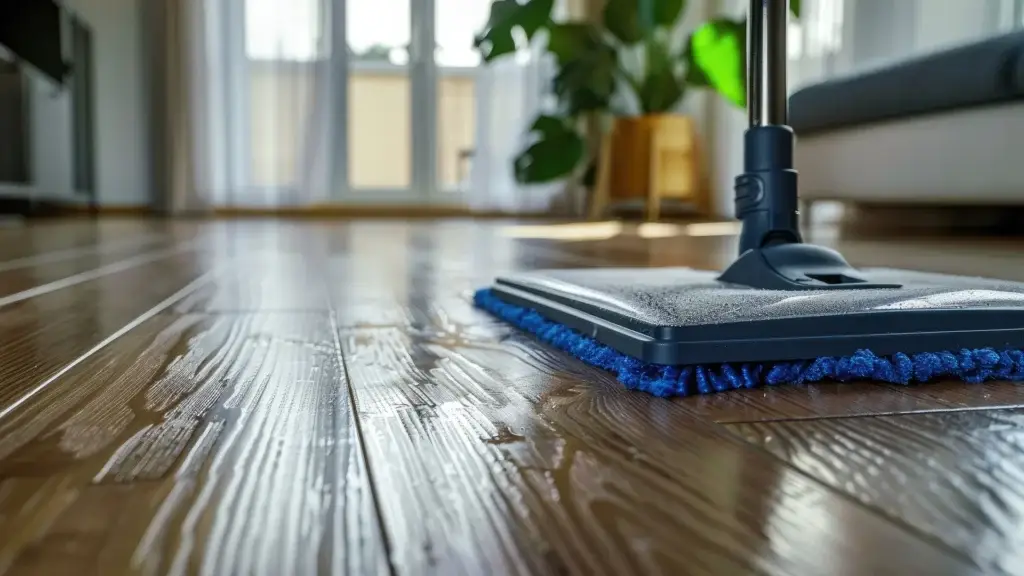
A flat microfiber mop with a swivel head is the best mop for hardwood floors for most households. It picks up dust and debris without requiring much moisture, the flat pad makes even contact across the boards, and reusable microfiber pads wash clean without leaving residue on the floor.
For larger spaces or if you prefer more control over moisture, a spray mop with a microfiber pad is a strong second option. It releases a fine mist directly ahead of the pad, so the floor is never damp for more than a few seconds.
Both options outperform traditional string mops, sponge mops, and steam mops for hardwood.
Why moisture matters when choosing the best mop for hardwood floors
Hardwood, whether solid or engineered, is a porous material. When water sits on the surface or penetrates the finish, the wood fibers absorb it and expand. Repeated exposure causes boards to warp, cup (edges rise), or crown (center rises).
The National Wood Flooring Association (NWFA) recommends maintaining indoor humidity between 30% and 50% for hardwood floors. In South Florida, indoor humidity without air conditioning regularly exceeds that range, which means the floor is already under moisture pressure before you mop.
Adding excess water during cleaning pushes the floor closer to its damage threshold faster. The best mop for hardwood floors in this climate is the one that uses the least moisture necessary to clean effectively.
Best option: flat microfiber mop
A flat microfiber mop is the top recommendation from flooring manufacturers and professional cleaners for hardwood floors.
Microfiber works through electrostatic action. The fibers attract and trap fine dust, hair, and debris without needing to be wet. When light cleaning is the goal, a dry microfiber pass picks up more surface debris than most wet mops applied to a floor that was not swept first.
For damp mopping, mist the pad lightly with a hardwood-safe cleaner. The pad should feel damp when pressed against the back of your hand, not dripping. If moisture sits on the floor as you mop, the pad is too wet for hardwood.
What to look for in a flat microfiber mop:
- Swivel head that pivots flat in any direction
- Washable, reusable pads (avoid disposable sheets, which contain surfactants that leave residue)
- Lightweight frame, ideally under 2 pounds
- Telescoping handle for height adjustment
Reusable pads should be washed without fabric softener. Fabric softener leaves a silicone coating on microfiber that transfers to the floor and dulls the finish over time.
Second option: spray mop with microfiber pad
A spray mop integrates a liquid reservoir and a trigger into the mop handle. Pressing the trigger releases a fine mist just ahead of the microfiber pad as you push forward.
This design solves the most common moisture problem with damp mopping: the mist is applied and absorbed almost immediately, leaving no standing water on the surface. It is particularly practical for larger rooms where a pre-dampened pad may dry out or pick up too much debris before the room is finished.
Fill the reservoir with a hardwood-specific cleaner only. Avoid vinegar solutions. Despite being widely recommended online, vinegar is mildly acidic and degrades polyurethane finishes with repeated use.
What to avoid: tools that damage hardwood floors
Professional cleaners frequently encounter floors damaged not by neglect but by the wrong tool used with good intentions. These are the most common offenders.
Steam mops. Steam forces concentrated moisture directly into the wood grain and beneath the finish. The heat also accelerates moisture absorption. Most hardwood flooring manufacturers void the warranty if steam cleaning is used. This includes steam mop products marketed as “safe for hardwood.”
String mops and sponge mops. Both hold far more water than hardwood can safely absorb. A wrung-out string mop still applies more moisture than a microfiber pad should. Water pools in the gaps between boards, which is exactly where long-term damage begins.
Abrasive scrubbing pads. Any pad with a rough surface scratches polyurethane, oil, and wax finishes. Once the finish is scratched, the bare wood beneath is exposed to moisture and staining directly.
Vinegar solutions. The acidity gradually dulls the finish. On a single use it may seem harmless. Over months of regular use, the finish develops a hazy appearance that is difficult to restore without refinishing.
All-purpose household cleaners. Most are too alkaline for hardwood finishes. They strip the finish’s protective properties and attract dust rather than repelling it.
The right cleaner to pair with the best mop for hardwood floors
The cleaner matters as much as the mop type. For polyurethane-finished hardwood, which covers most residential installations, use a pH-neutral, water-based hardwood floor cleaner.
Widely used options include Bona Hardwood Floor Cleaner, Method Squirt and Mop, and Rejuvenate All Floors Restorer. All are formulated to clean without leaving residue or degrading the finish.
If you are unsure what finish your floor has, apply a small amount of acetone to an inconspicuous area. If the finish softens or dissolves, it is wax or oil-based. If there is no visible reaction, it is almost certainly polyurethane. Oil-finished hardwood requires oil-specific cleaning products, not water-based cleaners.
Correct technique: getting the most from your mop on hardwood floors
Having the right mop and cleaner is not enough if the technique is wrong. These steps matter:
- Dry-sweep or vacuum first. Mopping over grit or debris drags abrasive particles across the finish. This is the most common cause of micro-scratches on hardwood floors.
- Apply cleaner to the pad, not the floor. Spraying directly onto the floor concentrates liquid in one area before the pad reaches it.
- Mop in the direction of the wood grain. Mopping across the grain pushes moisture into the gaps between boards. Following the grain keeps moisture on the board surface where it evaporates quickly.
- Work from the back of the room toward the exit. This prevents you from stepping on the freshly cleaned surface before it dries.
- Dry any pooled moisture immediately. If water sits in one spot, press a dry microfiber cloth over it. Do not leave standing moisture to air-dry on hardwood.
In South Florida’s humidity, drying time after mopping is longer than in drier climates. A ceiling fan or open window accelerates the process.
How South Florida humidity changes the approach
South Florida’s climate creates a specific challenge for hardwood floors that homeowners in other regions do not deal with at the same level. The floor is continuously managing ambient moisture, even when it has not been cleaned recently.
Indoor humidity in homes without continuous air conditioning can easily reach 70% or higher during summer months. At those levels, the wood is already absorbing moisture from the air. Adding moisture through cleaning compounds the effect.
The practical adjustments for South Florida:
- Run air conditioning consistently during summer to maintain indoor humidity below 50%
- Use even less water on the mop pad than you would in a drier climate
- Allow additional drying time before replacing furniture or allowing foot traffic
- Consider a whole-home dehumidifier if humidity-related floor movement is a recurring issue
Seasonal changes in board gaps or slight creaking are normal responses to humidity fluctuation in South Florida. Proper humidity management prevents these from becoming permanent warping or cupping.
Dealing with dull or sticky spots after cleaning
If floors look dull or feel slightly tacky after mopping, the cause is almost always product residue. Common sources:
- Oil soap leaves a film that attracts dust and prevents future refinishing
- Wax-based cleaners applied to polyurethane finishes build up over time and create a cloudy appearance
- Too much cleaner per pass means residue is not fully picked up by the pad
To remove residue, use a cleaner specifically formulated for residue removal (Bona Pro Series Residue Remover is widely used for this) applied with a microfiber pad and followed by a dry-pad buff pass.
For worn-through finish in high-traffic areas, or for floors that have not been refinished in many years, routine mopping will not restore the appearance. Refinishing requires sanding down to bare wood and reapplying finish layers. It is a professional job that requires the space to be vacated.
Finding the best mop for hardwood floors is just the start. For regular home cleaning that includes proper floor maintenance alongside the rest of your rooms, professional house cleaning services in South Florida use products suited to each surface type, including hardwood, tile, and vinyl.
Frequently asked questions
Is a Swiffer the best mop for hardwood floors? Swiffer dry pads work on hardwood for dust and hair removal. Swiffer WetJet solutions contain ingredients that can dull polyurethane finishes with regular use. Use a microfiber mop with a dedicated hardwood cleaner instead for damp mopping.
How often should I mop hardwood floors? Dry sweeping or vacuuming can be done as often as needed. Damp mopping is typically sufficient once a week for high-traffic areas and every one to two weeks for lower-traffic rooms. Over-mopping with a damp pad is a more common problem than under-mopping.
Why do my hardwood floors feel sticky after mopping? Stickiness after mopping is almost always residue from using too much cleaner, the wrong cleaner, or a cleaner that is not compatible with the floor’s finish. Switch to a pH-neutral hardwood cleaner and use significantly less of it per pass.
Are robot mops safe for hardwood floors? Most robotic mops use damp pads and small amounts of cleaner, which is comparable to damp mopping by hand. Check that the product you use is compatible with your floor’s finish. Avoid any robotic mop that soaks the pad heavily or uses steam.
Does humidity affect hardwood floors in South Florida more than other states? Yes. South Florida’s year-round humidity means hardwood floors here experience more moisture stress than floors in most other U.S. regions. Consistent air conditioning, the right mop and cleaner, and proper technique are all more important here than in drier climates.